Friday, March 20, 2020

Class of 2020 celebrates Match Day results

The University of South Alabama College of Medicine Class of 2020
The logistics of this year’s Match Day may have been different, but the spirit of the day remained the same.

Instead of gathering in one room and opening their envelopes simultaneously, most medical students opened their emails to find out where they would be doing their residency training. And rather than taking the stage to announce their placements and pin them on a map, students took to social media to share their news.

“Because of our duty to our community as responsible current and future healthcare providers, we have had to cancel aggregated Match Day celebrations for these soon-to-be graduates of our program,” said Kelly Roveda, M.D., associate dean of student affairs at the University of South Alabama College of Medicine. “As future healthcare providers who will be on the frontlines of providing care in their communities nationwide, our COM students recognize these responsibilities. We in the USA College of Medicine are confident that our rising physicians are ready to answer this call to serve.”

“The inability for us to celebrate together does not diminish our pride and excitement for our students,” Roveda added.

After interviewing with residency programs across the nation, medical students ranked their top-choice programs in order of preference. Training programs, in turn, ranked the students who interviewed. The National Resident Matching Program (NRMP) then used a mathematical algorithm to designate each applicant into a residency program. Nationally, nearly 45,000 applicants competed for 34,266 residency positions.

The process culminated on March 20, 2020 – Match Day – when USA College of Medicine seniors learned the results of the NRMP’s Main Residency Match. This year, USA medical students matched in 23 states, with 42 students matching out of state and 23 students matching in the state of Alabama. Eight of those students matching in Alabama matched at USA Health hospitals.

“Transitioning from the realm of undergraduate medical education to graduate medical education is what our College of Medicine students begin planning early in their studies,” Roveda said. “The questions they ask themselves are numerous and include: ‘What specialty will I choose? What is the length of the training program? Where will I pursue my training? Will I pursue a fellowship? How will my decisions affect my family?’ Some of these questions were answered for our medical students today.”

Josh and Taylor Ousley
Married medical students Josh and Taylor Ousley tackled those questions together. According to the NRMP, when applicants participate in the match as a couple, they match to the most preferred pair of programs on their rank order lists where each partner has been offered a position.

“Our biggest factors we considered when applying to residency were that we wanted to have a successful couples match and end up together, and we wanted to stay in the Southeast to be close to both of our families,” said Josh Ousley of Alabaster, Alabama.

The couple matched at the University of Alabama at Birmingham Hospital, where Josh will train in internal medicine and Taylor will train in psychiatry.

The pair met and started dating during their first year of undergrad at the University of Alabama at Birmingham. They applied for early decision and were accepted into the USA College of Medicine’s class of 2020. On New Year’s Eve of their first year of medical school, Josh proposed to Taylor at the Moon Pie Drop in downtown Mobile. They married five months later on June 3, 2017.

“The past four years of us both being in medical school has been a learning experience for us as we started our marriage, but it has also been one of the most rewarding and fulfilling times of my life. We have really learned to rely on each other for support and this has made our marriage that much stronger,” said Taylor Ousley of Helena, Alabama. “Medical school is hard for anyone, but I think it made it easier to always have someone by my side going through the same thing that I was.”

Jazmín Scott
Jazmín Scott of St. Martin, Mississippi, learned her results in December as part of the military match. But, she kept her placement a secret from her family and friends until the rest of her classmates found out on Match Day. She matched in psychiatry at Tripler Army Medical Center in Hawaii.

Having grown up with both parents in the military, Scott made the decision to join the U.S. Army as a senior in high school. The decision to go into medicine came later. She graduated from the University of Oklahoma with a degree in health and exercise science but felt unfulfilled in her career.

“I spent a lot of time that summer exploring my options and realized that a career in medicine would give me the opportunity to give back to the community,” she said.

The Health Professions Scholarship Program offered by the military allowed Scott to pursue medical school at the USA College of Medicine, where she has formed close friendships and had a positive educational experience.

“Recently, I had the best experience of seeing a patient again after over a year and realizing that they remembered me, too,” Scott said. “It was really meaningful to me because I was glad to see how well they were doing, but it was also incredible to realize that I had made a positive impact on another person.”

Will Martin
Will Martin of Spanish Fort, Alabama, knew from an early age that he wanted to be a doctor. As a Native American, he watched family members manage chronic health issues such as heart disease and diabetes. When Martin graduates from the USA College of Medicine, he will become the first physician from his tribe, the Poarch Band of Creek Indians.

“I hope that my path to higher-level education provides encouragement and guidance to those who come behind me seeking advanced knowledge,” he said. “It was not until the late 1960s that members of my tribe were even allowed to attend education higher than the 6th grade. Therefore, there is not as much as a push for tribal members to strive for upper-level education, and I hope to change this mindset.”

Martin, who matched in anesthesiology at Wake Forest Baptist Medical Center in Winston-Salem, North Carolina, is grateful for the hands-on education he received at the USA College of Medicine.

He remembers seeing an active code in the emergency department and volunteering to assist with CPR. “While I was giving compressions, I felt the patient’s heart knock against my palms,” he said. “That was the moment I realized that my actions truly had an impact on the life of another human being.”

Another impactful experience for Martin was participating in the Christian Medical Ministry of South Alabama’s recent mission trip to Rwanda, where the group “learned how to use our gifts as medical professionals to glorify God in all that we do,” he said

Bonnie Holley
Bonnie Holley of Arab, Alabama, was also among the volunteers in Rwanda. The trip marked her fourth mission as a USA medical student, having traveled to Senegal, Honduras and Costa Rica in past years.

“I have always had a heart for overseas mission work, and I thought I wanted to be an engineer to help create clean water projects and other infrastructure in developing nations,” Holley said. “However, over time I realized that engineering just wasn’t for me.”

So, after two years of studying engineering at Auburn University, Holley changed her major to biomedical sciences and later applied to medical school at the USA College of Medicine.

With the intent to do global mission work after completing her residency training, she said, “I tried to choose programs that have a rural surgery focus and/or a wide variety of operative training as I will likely have a very broad scope of practice wherever I end up.”

Holley matched in general surgery at Gundersen Lutheran Medical Center in LaCrosse, Wisconsin.
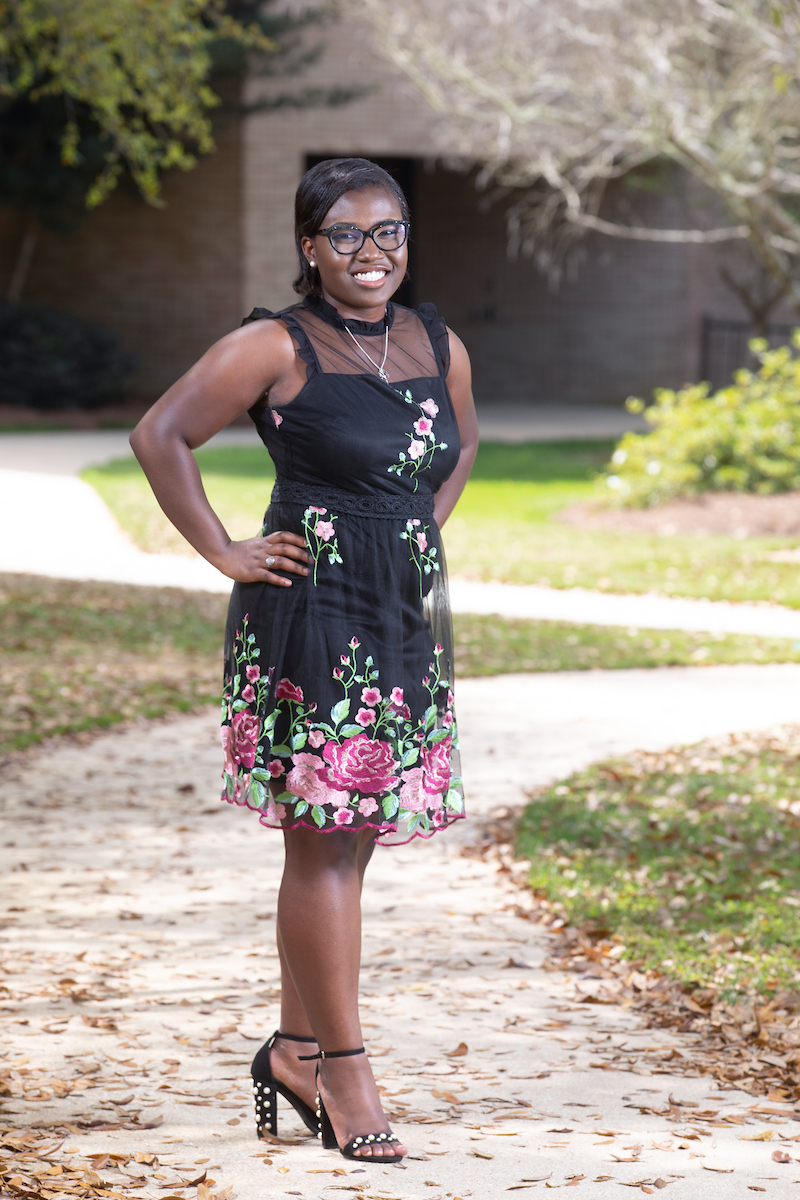
Destini Smith
Growing up in Birmingham, Destini Smith knew not only that she wanted to be a doctor but also what specialty.

“I knew I wanted to be a child neurologist ever since I was little and have it documented in my journal,” said Smith, who matched in child neurology at UAB Hospital. “I have grown up wanting to be the doctor to care for children with seizures, and that has continued to be a passion of mine to this day.”

In her first year at the USA College of Medicine, Smith went to a meeting for the Student Interest Group in Neurology, but she was the only student in attendance. Now she serves as president of the interest group, which has significantly higher meeting attendance these days.

A highlight of her medical education was performing research with Errol Crook, M.D., professor and Abraham Mitchell Chair of Internal Medicine, and Kenneth Hudson, Ph.D., associate professor of sociology and anthropology at USA. Their work, which was published in Preventative Medicine Reports, focused on healthcare utilization and the doctor-patient relationship.

Davis Diamond
Davis Diamond of Norcross, Georgia, said one of the most impactful experiences for him was working with the underserved population in Mobile during his third year. “As M3s, South gives us enough autonomy so that we can get to know our patients on a personal level,” he said.

On campus, Diamond has been involved in the Curriculum Committee as well as the Student Promotion and Evaluation Committee. He also helped to restart the Dermatology Interest Group, which he hopes leads more USA medical students to pursue the field in the future.

After a transitional year at WellStar Kennestone Regional Medical Center in Marietta, Georgia, Diamond will begin his residency training in dermatology at the Medical College of Georgia in Augusta.

“This is a goal I have been working towards for about a decade, with the final payoff being landing a residency spot in my desired specialty of dermatology. I have been so lucky to have an amazing support system in my wife, family and friends. I just want to make them proud,” Diamond said. “This is an extremely long, arduous (but also fun!) process, so it is nice to know where my training and journey will culminate, and to finally have the opportunity to give back to all those who have sacrificed for me along the way.”

View the full 2020 Match Day results.

USA medical students rally to donate ‘match money’

The ceremony to celebrate their transition to residency cancelled, fourth-year medical students at the University of South Alabama College of Medicine are donating their “match money” to charity and they’re asking supporters to match the gifts.

“One of the USA College of Medicine’s Match Day traditions is to drop $5 into a doctor’s bag as you go on stage to announce where you matched, and the last person to go up takes home the money,” said Kelsea Wright, a member of the Class of 2020. “This year, in light of the COVID-19 pandemic and our Match Day ceremony being cancelled, we have decided to donate our ‘match money’ to Feeding the Gulf Coast, and we are asking our friends, family and faculty to match our match and donate $5.”

The Match Day ceremony for the Class of 2020 was set for today, March 20, at Christ United Methodist Church, but was cancelled along with other large gatherings in light of the COVID-19 pandemic. Medical students will still participate in the National Resident Matching Program, but will receive their envelopes individually to discover in which residency program they will train for the next few years.

Wright said that the #MatchOurMatch campaign, an idea borrowed from a medical school in another state, is giving her and her classmates something to do now that they have finished their clinical training.

“I have talked to several of my classmates, and we all agree that we feel almost purposeless, which is a foreign concept for us, as we have always had something concrete to work toward for the last four-plus years,” she said. “It makes my heart happy to see my class coming together like this, and it makes me so thankful to be part of the Class of 2020.”

Wright said that a $5 donation would provide 25 meals to those in need.

“We in the College of Medicine are proud of the manner in which our soon-to-be graduates are working within our community to assist in any way possible," said Kelly Roveda, M.D., associate dean of student affairs. “Our students recognize that as future healthcare providers, they will be looked to as leaders in the communities in which they will practice.”

Visit https://app.mobilecause.com/vf/MatchOurMatch to donate.

USA College of Medicine mourns loss of internal medicine professor

Joseph Potter Michalski, M.D., who served as professor of internal medicine at the University of South Alabama College of Medicine and a rheumatologist with USA Health, passed away on March 13, 2020. The Mobile resident was 75 and recently retired from USA Health.

A Montgomery native, Michalski received his medical degree from the University of Maryland-Baltimore in 1970. He completed a residency at San Francisco General in San Francisco. He did research for many years in California and at Louisiana State University in Baton Rouge before joining USA.

“It was an honor to work with Dr. Michalski,” said Errol D. Crook, M.D., professor and Abraham Mitchell Chair of Internal Medicine and director of the USA Center for Healthy Communities. “He was a great physician and a great colleague. He will be greatly missed.”

Read the obituary for Joseph Potter Michalski, M.D.

Thursday, March 12, 2020

Rwanda medical mission trip ‘a jewel in our curriculum’

Faculty and medical students from the University of South Alabama College of Medicine cared for patients at Kibogora Hospital in Rwanda as part of a medical mission trip with the Christian Medical Ministry of South Alabama.
Practicing medicine in remote areas of the world presents challenges for even the most seasoned clinicians. For medical students, the experience allows them to apply the knowledge and skills they’ve learned in a completely unfamiliar setting, creating numerous teaching moments they will carry with them for the rest of their lives.

Representing the University of South Alabama College of Medicine and USA Health, a group of 25 clinical faculty members, fourth-year medical students, advanced care providers and support personnel recently served on a month-long medical mission trip in Rwanda. Since 2012, the Christian Medical Ministry of South Alabama (CMMSA) has led the annual trip to Kibogora Hospital, a rural referral hospital in Rwanda.

Andrew Bright, D.O., assistant professor of surgery at the USA College of Medicine, has participated in the Rwanda mission as a medical student, resident, fellow and twice as an attending physician. Each trip is unique in terms of the pathology encountered, group dynamics, and intended specialties and goals of the students, he said.

“I have noticed that senior medical students, displaced from their normal environment, tend to have that same amazement that they had when they saw their first patients,” Bright said. “I get to witness a new beginning of sorts when they see 30 to 40 patients in the same ward, which is a large room. There is barely enough room to walk bed to bed as the whole room is full.”

Fourth-year student Kelsea Wright, who is pursuing an anesthesiology residency, assisted in anesthetic procedures for surgery. “At USA, we are encouraged to be very hands on and to take responsibility for our patients, even as students, which helped prepare me for the increased autonomy I was given during this trip,” she said. “During my anesthesiology rotation at USA, I performed multiple intubations and spinal blocks, so when the opportunity came for me to perform those procedures at Kibogora Hospital, I felt confident in my abilities, with some guidance from the CRNAs.”

As a fourth-year student going into emergency medicine, Travis Goodloe III worked in the procedure room performing laceration repairs, abscess drainages, minor excisions, burn and wound care, and dressing changes. He also coordinated the delivery of medical supplies the group donated to the hospital, which is often burdened by a shortage of supplies and qualified staff.

“There is an endless flow of patients that funnel into Kibogora Hospital, thus having USA physicians, residents, and medical students present for a month really allows for a stress reliever on the existing medical system,” Goodloe said. “The local staff that we interacted with during our trip made it very clear how grateful they are for this. It truly keeps the hospital afloat in a lot of ways.”

Bright, who also serves as a trauma, critical care and burn surgeon with USA Health, said the hospital’s lack of tools and technologies he is accustomed to using in the United States forced him to become a more resourceful surgeon. The staff at Kibogora, which includes only one general surgeon, are experts at maximizing the reach of materials and minimizing waste, he said.

“We operated successfully on a 94-year-old man with large chronic burn-related wounds of the legs. I had to set up the whole case from start to finish, not just ‘my part,’” Bright said. “There were no blood transfusions available, and blood loss was expected as he had significant tissue destruction. We had to find enough ACE dressings in the hospital to facilitate mechanical hemostasis, and mix our own epinephrine bath for hemostasis. We had to mix our own antibiotic solution, made with bleach.”

In addition to addressing the patients’ medical needs, the hospital staff and volunteers tended to the patients’ spiritual needs.

“The hospital has a few chaplains and a prayer team that visit the wards each Sunday afternoon to sing songs with the patients,” Wright said. “We joined them for two Sundays, and it was so moving to see the patients and their families filled with joy as they sang, danced and clapped.”

Goodloe was also touched by the Rwandan people’s culture and focus on spirituality, he said.

“They are often more vocal and intentional about their faith than many of us are here in the U.S.,” Goodloe said. “Their freedom of worship even within the hospital during spiritual rounds on Sunday afternoons was powerful and eye opening to many of us. I do believe that these spiritual rounds consisting of praying, singing and dancing, and worship provided just as much healing as any medical care that we were able to provide.”

A particularly moving experience for Goodloe was a home visit. The patient lived high in the mountains, in a small mud home with dirt floors and no electricity. Goodloe, classmate Will Martin, and the palliative care nurse from the hospital provided care for the patient, who was a quadriplegic and no longer able to provide for his family of eight children. As they talked with him about how to care for his wounds at home, the patient described how he trusted in God’s plan for him and his family.

“This experience demonstrated the value of a robust and healthy faith, even in light of unhealthy and unfortunate physical conditions,” Goodloe said. “For all of these reasons, this experience was the most impactful of the trip for me, far more so than any specific medical care, procedure or surgery that we were able to provide over the course of our month in Rwanda.”

In the summer of 2017, after completing their first year of medical school, Wright and Goodloe spent two weeks in Senegal, West Africa, as part of a medical mission trip with CMMSA. Their experiences in Senegal largely influenced their decisions to take part in the Rwanda trip.

Rwanda was the first medical mission trip for Dorothy Dickinson, GME program coordinator for surgery. She assisted with spiritual rounds and met with the chaplain to help structure the hospital’s weekly Bible studies.

“When a person can commit their time to a mission trip to see the needs and opportunities around the world involving other people of different cultures, it gets into your heart,” Dickinson reflected. “This changes everything including how you spend your time, energy and resources.”

Goodloe called the Rwanda trip “a true jewel in our curriculum.”

“The opportunity for learning and the opportunity for development of young physicians on so many levels during this trip is totally invaluable. It is worth its weight in gold,” Goodloe said. “I have no doubt that I will begin residency in a few months much better prepared clinically, emotionally, spiritually and personally than had I not immersed myself in this Rwanda experience for the past month.”

Visit www.cmmsa.org to learn more about the Christian Medical Ministry of South Alabama.

Wednesday, March 11, 2020

Vande Waa named to state coronavirus task force

John A. Vande Waa, D.O., Ph.D., professor of internal medicine at the University of South Alabama College of Medicine, is one of four infectious disease specialists serving on Gov. Kay Ivey’s 18-member task force to prevent the spread of the coronavirus in the state.

The task force will discuss developments and precautions on a routine basis and make recommendations to the governor as necessary, Ivey’s office said. State Health Officer Dr. Scott Harris will chair the group, and lead any public announcements and directives, the governor’s office said.

"The safety of Alabamians is paramount, and we will do everything we can to limit exposure to this illness," Ivey said in a press release. "I appreciate the willingness of these individuals, from both the public and private sector, to serve as we do everything we can to mitigate risk for the people of Alabama and to keep the citizens of the state informed of our plans."

Board-certified in infectious disease, Vande Waa earned a medical degree from Michigan State University College of Osteopathic Medicine and completed both residency and fellowship training at the University of Wisconsin in Madison.