Thursday, July 30, 2020

M1s get first taste of medical school during COVID-19

A group of first-year medical students takes a tour of campus during M1 orientation. 
First-year medical student TiAriel Anderson took a seat at a table in the Small Group Learning Center, which was rearranged to allow for social distancing due to COVID-19. Through a mask, she reacted to her first day of orientation at the University of South Alabama College of Medicine.

“I feel a little bit of nerves, but I feel prepared,” said Anderson, of Monroeville.  “I’m not going to doubt myself.”

Her classmate, Tiara Dean, put it another way: “We’re making history,” she said, referring to the new world of medical education during COVID-19.

Franklin Trimm, M.D., associate dean for diversity and 
inclusion at the USA College of Medicine, greets first-year 
medical student Trentyn Shaw.
On Monday, Anderson and Dean were in the first group of M1s to attend an in-person orientation talk on unconscious bias, get photos taken and tour the medical school. Most of the week’s orientation sessions and ice-breaker activities for the 74-member class were moved online to allow for social distancing.

T.J. Hundley, M.D., associate dean for medical education, said the curriculum will remain the same though the delivery method will be different this year. First- and second-year students are being divided into three groups and will take turns attending lectures online and in-person at the medical school.

“The faculty will be making sure to deliver content in a focused way,” said Jeffrey Sosnowski, M.D., Ph.D., assistant dean for curriculum integration. “We have to make sure we keep the students engaged.”


Tuesday, July 28, 2020

USA Medical Alumni Association to host virtual CME courses

The University of South Alabama Medical Alumni Association is hosting three upcoming opportunities for continuing medical education. 

“Following the University's decision not to hold in-person events until spring 2021, the USA Medical Alumni Association has identified digital avenues to connect with our graduates,” said Ann Eleece Kouns, associate director of medical alumni relations at the USA College of Medicine. “These presentations allow us to offer CME credits while showcasing the myriad of resources and programs the USA College of Medicine and USA Health have to offer. We look forward to welcoming our friends and family across the College of Medicine, USA Health and the local community to these presentations.”

The first course, "The Evolution and Expansion of COVID Testing at USA Health," is set for Wednesday, Aug. 19, from 6 to 7 p.m. via Zoom.

Presenters are Michael Chang, M.D., chief medical officer and associate vice president of medical affairs at USA Health; Natalie Fox, DNP, chief nursing officer and assistant administrator at USA Health; Benjamin Estrada, M.D., professor and vice chair of pediatrics at the USA College of Medicine and a pediatric infectious disease specialist at USA Health; and Mike Zang, director of perioperative services at USA Health.

 Register by Aug. 10 at https://medicalalumni.southalabama.edu/pages/evolution-and-expansion-of-covid-testing.

 Mark your calendar for other courses in the series:

"Why Diversity Matters in Healthcare"
Franklin Trimm, M.D., Associate Dean of Diversity and Inclusion and Assistant Vice President for Medical Affairs
Wednesday, Oct. 14, 2020 6 to 7 p.m.
https://medicalalumni.southalabama.edu/pages/why-diversity-matters-in-healthcare

"Social Determinants of Health: A Focus on Poverty"
Errol Crook, M.D., Professor and Abraham Mitchell Chair of Internal Medicine
Wednesday, Feb. 24, 2021 6 to 7 p.m.
https://medicalalumni.southalabama.edu/pages/social-determinants-of-health

The presentations are free, but registration is required to attend. Each course is approved for one credit hour/unit of continuing education.

Thursday, July 23, 2020

USA Health magazine highlights College of Medicine students, faculty

USA Health magazine features stories from all facets of the health system and the University of South Alabama College of Medicine.

In the latest edition, read about senior medical students' journeys to residency and how students are exploring human anatomy through virtual reality. The magazine also highlights faculty and student research, academic achievement and community outreach.  

Check out the full magazine on issuu.com.

Welcome, Class of 2024 medical students

Next Monday, July 27, the University of South Alabama College of Medicine will welcome 74 new medical students, the Class of 2024. Because of COVID-19, their orientation will be a week like no other in the medical school’s history – a mix of presentations on Zoom, small-group meetings in person and virtual social activities to break the ice.

“Beginning medical school can be a difficult transition under the best of circumstances. Starting medical school with orientation that is largely virtual due to COVID-impacted changes will be part of the history for the Class of 2024,” said Kelly Roveda, M.D., associate dean for student affairs at the USA College of Medicine. “These young people have been working for several years to get here, and now ‘here’ may largely be their own living room or kitchen.”

Roveda praised the three second-year medical students who, as orientation leaders, worked through the summer to revamp the previous orientation plan. “We have been extraordinarily fortunate that the orientation leaders from the Class of 2023 have risen to the challenge,” she said.

The new plan calls for students to spend half of each day in Zoom sessions to hear a welcome and presentations on subjects ranging study strategies and financial aid to wellness and basic life support training. Students will be on campus only once during the week in small groups for training, photos and a tour, during which they will wear masks and abide by social distancing guidelines.

Orientation leaders Emily Elliot, Claire Cawthon and Kasey Grant Andrews arranged for virtual office hours during which students can join Zoom and immediately connect with an upperclassman. “Several people in the second-year class have stepped up and offered to give out their emails and phone numbers so that the M1s can contact them even into the semester,” Andrews said.

Cawthon created virtual ice breaker activities so that students could get to know one another in the evenings.

“Medical school is hard enough, even in person. Being online is another barrier they will have to overcome,” Andrews said. “We’re trying to find ways to make the transition easier for them.”

Wednesday, July 22, 2020

USA College of Medicine research examines novel genetic pathway that could treat COVID-19

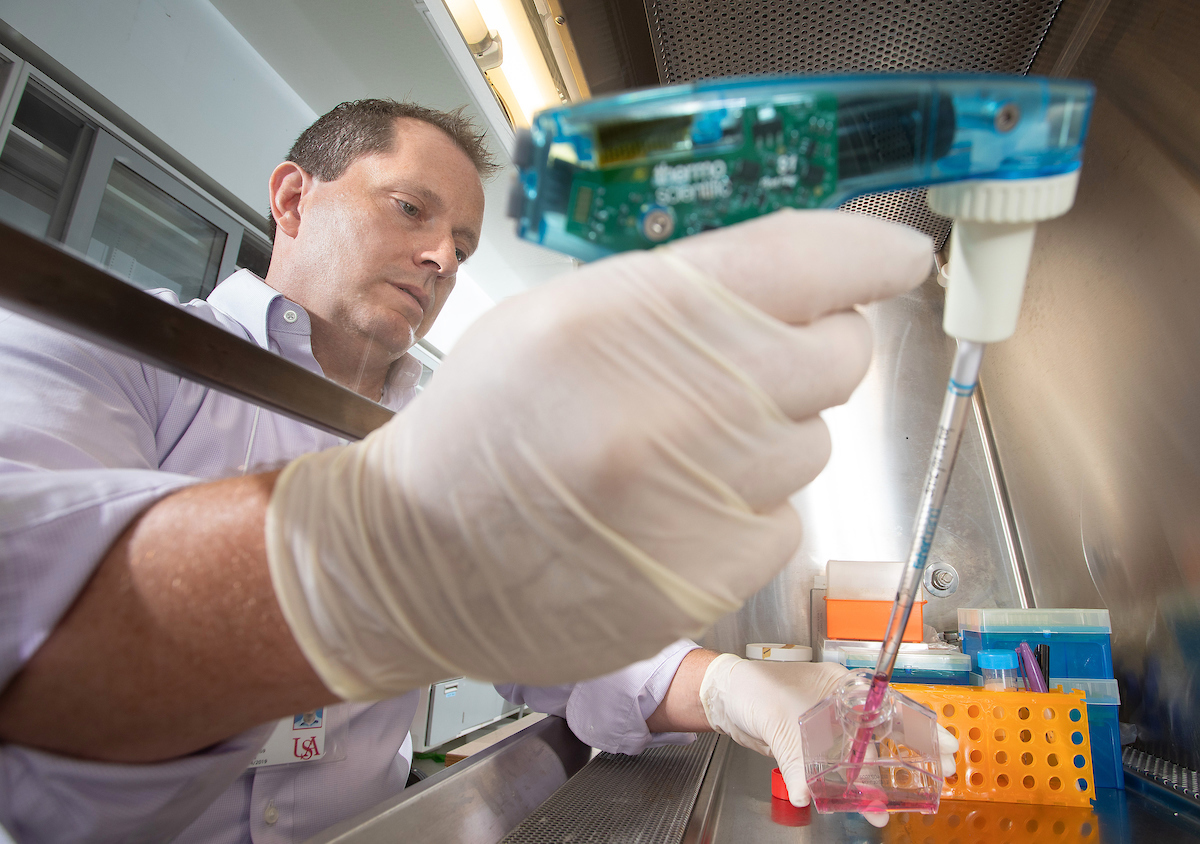
Glen Borchert, Ph.D., associate professor of pharmacology, is collaborating on COVID-related research at the USA College of Medicine.
A recent discovery at the University of South Alabama College of Medicine shows there is a contributor in the body that helps fight viral infections. According to Glen Borchert, Ph.D., associate professor of pharmacology at the USA College of Medicine, his team found that the body pumps a new form of transfer ribonucleic acid (tRNA) fragments into lung fluid which helps target respiratory viruses.

The team at the Borchert laboratory at the USA College of Medicine is exploring why tRNA fragments are flowing in and out of lung cells and how this flow could combat respiratory viruses, such as the novel coronavirus. The team plans to test the tRNA fragments’ ability to restrict SARS-CoV2, the virus causing COVID-19.

The National Science Foundation awarded the Borchert laboratory $200,000 for further research into the discovery. The USA College of Medicine is the only institution in the nation awarded a grant on this specific research topic.

“With this funding, our work can go further as we begin to better understand how the body naturally fights infections,” Borchert said. “Once we’ve collected the data from testing the tRNA fragments, we can work towards more therapeutics for patients battling viral infections.”

Natalie Bauer, Ph.D., associate professor of pharmacology; Jin Hyun Kim, DVM, Ph.D., assistant professor of microbiology and immunology; graduate student Dominika Houserova; and medical student Ravi Rajendra are collaborators on the project.