Thursday, May 29, 2025

Meet a Ph.D. Student: Haley Kominek

Haley Kominek

Hometown: Pace, Florida

Previous education: B.S. in biomedical engineering, Mississippi State University

Basic Medical Sciences Graduate Program track and year of study: Biomedical Engineering and Bioinformatics, third year

Faculty mentor: Glen Borchert, Ph.D., professor of pharmacology

Current research: My current research focuses on extracellular RNA mediated cell communication — specifically, how RNA modifications may be playing a role in designating RNA for the secretion from cells or uptake by recipient cells.

What do you enjoy most about being a graduate student at the Whiddon COM?
I enjoy the collaborative environment of the College of Medicine. I have also been given many opportunities to grow as a scientist. Most importantly, I enjoy that I am close to my and my husband's families.

Interests and hobbies: I enjoy painting, doing DIY home projects, going out on the jet ski, and going fishing with my husband.


MAA requests 'A Note for Every White Coat'

The USA Medical Alumni Association is proud to provide Whiddon COM students with their very first white coats. As a part of this special tradition, the alumni association includes a handwritten note card in the pocket of every white coat when they are presented to students at the White Coat Ceremony.

The MAA needs your words of encouragement and advice for these notes. They request that you submit your own special message via email to medalum@southalabama.edu by June 9. 

Medical Student Summer Research Program begins at Whiddon COM

Students participating in summer research attended orientation.
The 52nd Annual Medical Student Summer Research Program officially kicked off with orientation on Wednesday, May 28, marking the start of a busy and exciting summer of research at the Whiddon College of Medicine. This year, 53 students — 44 rising M2s and nine incoming M1s — are participating in the program.

Program coordinators are Skye Andrade and
Marcina Lang.
The eight-week program pairs medical students with faculty mentors, and students devote 30 to 40 hours a week to a research project. The summer experience includes hands-on research related to basic science and/or clinical medicine, a seminar program that focuses on various scientific and clinical topics, and student presentations. Through the program, students develop an appreciation of how research contributes to the knowledge and practice of medicine.

The program will culminate with student presentations on the 52nd Annual Medical Student Summer Research Day, scheduled for Friday, July 25, from 8:30 a.m. to 2 p.m. in the Medical Sciences Building. Oliver McDonald, M.D., Ph.D., an associate professor of pathology and laboratory medicine at the University of Miami Miller School of Medicine, will deliver the keynote lecture.

Chair of the summer research program is Jonathan Rayner, Ph.D., and coordinators are Skye Andrade and Marcina Lang. Support for the program is provided by the Dean's Office.

Learn more about the Medical Student Summer Research Program.

Whiddon COM’s Office of Accreditation and Planning shares expertise at national APQI Conference

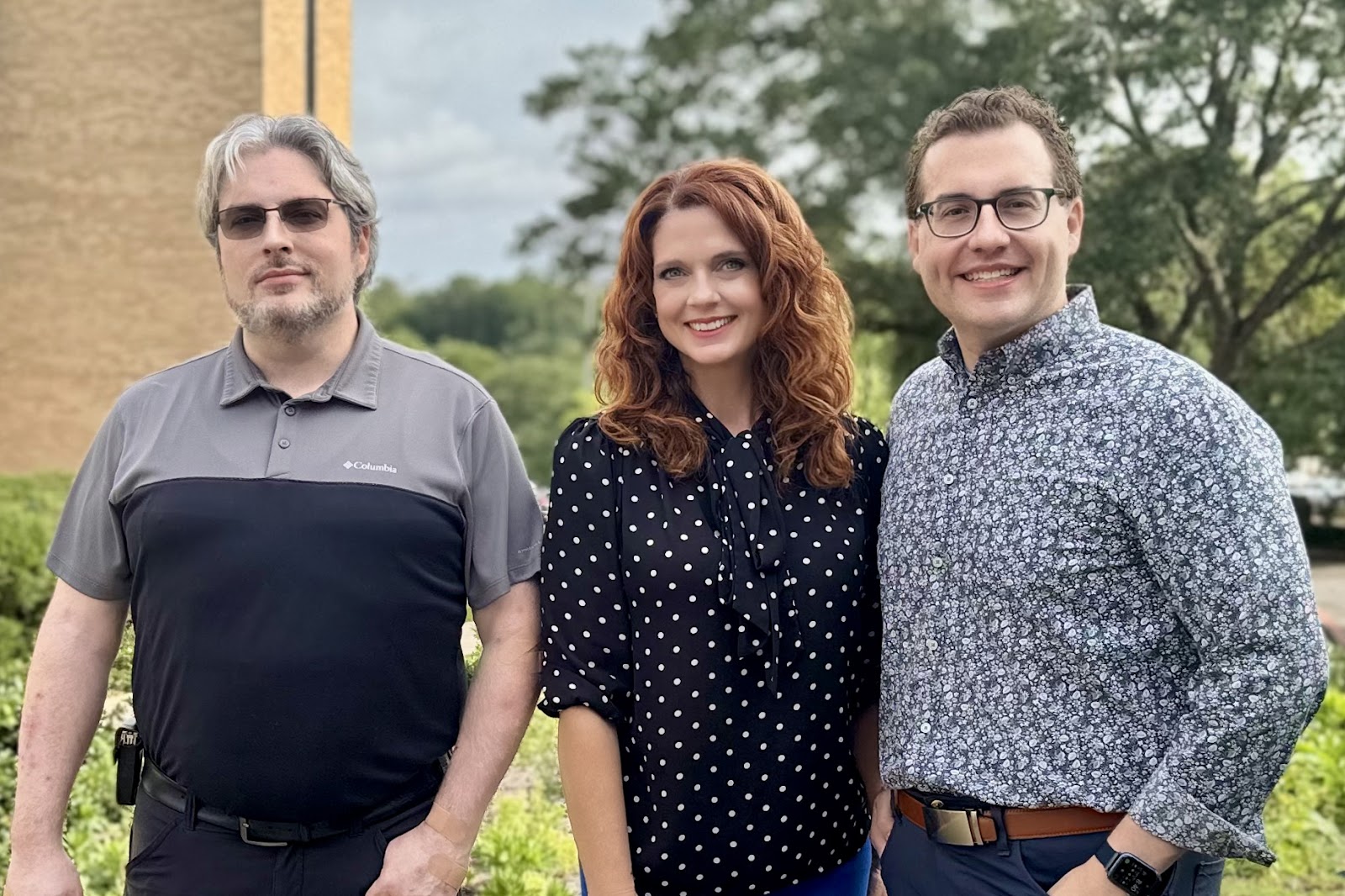
Russell Cantrell, MSCIS, MBA; Melisa Pierce, Ed.D., MPA; and David S. Williams, Ph.D., MPA, presented at the virtual conference.
Three members of the Whiddon College of Medicine’s Office of Accreditation and Planning presented at the 2nd annual Accreditation Preparation & Quality Improvement (APQI) Conference, held virtually on May 21. Centered on the theme “Growing the Choir of APQI Professionals,” the conference brought together leaders, practitioners and researchers from medical schools across the country to share innovations and best practices in accreditation readiness and continuous quality improvement (CQI).

Melisa Pierce, Ed.D., MPA, director of quality improvement, and David S. Williams, Ph.D., MPA, assistant dean for institutional and academic success, co-presented a two-part session focused on the Data Collection Instrument (DCI) — a central component of the Whiddon COM’s LCME accreditation efforts — and its role in shaping a culture of CQI.

In “The DCI Overture: Setting the Stage for Accreditation Readiness,” Pierce and Williams introduced a proactive, CQI-based framework that includes structured committee roles, integration of student feedback, and the use of an accreditation readiness heat map to monitor progress. Their approach emphasized how strategic planning and collaboration reduce last-minute efforts and increase institutional transparency.

Their follow-up session, “The DCI Encore: Elevating CQI Through Collaboration,” guided attendees through practical tools and peer-driven strategies to apply these models in other institutional settings. Through a virtual gallery walk, participants exchanged ideas on committee structure, data visualization, and embedding student input, ultimately identifying actionable ways to advance CQI through the accreditation process.

Russell W. Cantrell, MSCIS, MBA, director of data administration and strategic initiatives, presented “Melody in Metrics: Crafting Charts That Hit the Right Note.” His session explored the power of data visualization to transform raw numbers into coherent and compelling narratives. Drawing on principles of perception and design, Cantrell demonstrated how thoughtful use of layout, color and scale can enhance understanding, drive decision-making, and support institutional effectiveness, especially in the context of accreditation. 

“Good charts rely on rhythm and clarity,” said Cantrell. “When space, color, and structure are used with intention, data stops being noise and starts making sense.”

In addition to her co-presentations, Pierce also facilitated a dedicated networking session titled “Best Practices for CQI,” during which participants shared strategies, challenges and solutions for embedding continuous quality improvement across their institutions.

“This year’s APQI conference was an opportunity to both share our work and learn from the collective experience of colleagues across the country,” Pierce said. “Our goal is to help institutions approach accreditation not just as a compliance exercise, but as a catalyst for long-term improvement.”

Williams added, “We’re proud to be part of this growing national conversation and to highlight how collaboration, structure and design can shape more effective and sustainable accreditation practices.”

The Whiddon COM Office of Accreditation and Planning continues to lead in aligning data strategy with collaborative processes, ensuring that CQI and accreditation efforts not only meet standards but also drive meaningful and measurable progress.

USA scientist awarded NIH grant to study how Lyme disease invades the nervous system

Timothy Casselli, Ph.D., is studying the mechanisms of how the bacterium that causes Lyme disease enters the central nervous system.
By Casandra Andrews

Timothy Casselli, Ph.D., an assistant professor of microbiology and immunology at the Whiddon College of Medicine, has been awarded a two-year grant for $385,000 from the National Institutes of Health to study how Lyme disease invades the central nervous system.  

The ultimate goal of his research is to identify treatments for Lyme disease, a complex infection transmitted by ticks most often during the hottest summer months.  

“Because there are no vaccines or effective vector controls against the infection, the disease is and will continue to be a significant public health concern,” Casselli said. 

Lyme disease is the most common tick-borne disease, with more than 300,000 new cases diagnosed each year, according to the Centers for Disease Control and Prevention. The number of new cases has been increasing in recent years, and the areas where ticks are found are expanding, which puts more people in more states at potential risk. 

Caused by infection with the tick-borne pathogen Borrelia burgdorferi, Lyme disease can lead to inflammatory health conditions impacting the joints, heart, and nervous systems. Neurologic disease, referred to as Lyme neuroborreliosis, can include meningitis, cranial and peripheral neuritis/neuropathy, and encephalopathy. 

Work conducted with grant funds on this project will provide the foundation for a long-term research program focused on mechanisms of Lyme neuroborreliosis pathogenesis, Casselli said. 

The bacterium that causes Lyme disease, Borrelia burgdorferi, can enter the central nervous system causing disease. This central nervous system invasion only occurs in some Lyme disease patients, although the reasons for differences in infection outcomes are unknown. To address this, the study will use a lab model of Lyme disease to identify the site of entry and host immune responses that influence bacterial entry into the central nervous system.  

Understanding the mechanisms of central nervous system entry by Borrelia burgdorferi could lead to the identification of novel risk factors to explain or predict the different outcomes between Lyme disease patients, as well as inform the development of novel diagnostic tests and treatments for neuroborreliosis. 

Casselli, who joined USA in 2025, earned a Ph.D. in immunology and infectious diseases from Washington State University in Pullman, Washington; an M.S. in microbiology and infectious diseases from the University of Calgary in Calgary, Alberta, in Canada; and a BMS degree in microbiology and immunology from what is now Western University in London, Ontario.  

A member of the review editorial board for the journal Frontiers in Microbiology from 2016-2022, Casselli is also a member of the American Association of Immunologists and the American Society for Microbiology.  

Overall, his research seeks to identify how Borrelia, the bacteria that causes Lyme disease, can access the central nervous system and the mechanisms leading to disease known as neuroborreliosis. 

Learn more about his research.