Tuesday, June 23, 2020

Class of 2022 cloaked with white coats in virtual ceremony

Students entering their third year of medical school at the University of South Alabama College of Medicine donned their white coats at a virtual ceremony on Friday, June 19.

Separated by social distancing requirements, 79 students convened on the digital meeting platform Zoom to take the Medical Student Oath, a promise to uphold the human aspects of medicine such as sensitivity, compassion and respect for patients. Linda Ding, M.D., assistant professor of surgery at the USA College of Medicine, delivered the keynote address.

Ding touched on humanism, professionalism, empathy and compassion, as well as the work-life balance.

“If I had my way, instead of a white coat, I would have each of you don a patient’s gown,” she said. “Very few of us have had that experience, and yet our job is to care for patients and alleviate suffering. The best substitute for the firsthand experience as a patient is curiosity.”

Ding urged the students to be mindful and present in each moment spent with a patient. “In doing so, you will engage in a shared experience, one that will enrich your character and move you to action on behalf of your patients,” she said.

Also during the ceremony, Ding, three residents and 10 rising fourth-year medical students were inducted into the Arnold P. Gold Foundation Gold Humanism Honor Society. Inductees are chosen by current third-year medical students for practicing patient-centered medical care with altruism, integrity and compassion.

Inductees included rising fourth-year medical students Nkemdi Agwaramgbo, Grayson Domingue, Dala Eloubeidi, Tyler King, W. Hamilton Moore, Raymond Moosavi, Ravi Rajendra, Jordan M. Smith, Gisella Ward and Zachary White. Residents included Sara McConnell, D.O., a resident in the department of internal medicine and pediatrics; Taylor Twiggs, M.D., a resident in the department of obstetrics and gynecology; and Jonathan Bernard, M.D., a resident in the department of surgery.

The USA Medical Alumni Association sponsors the White Coat Ceremony each year.

USA College of Medicine hosts virtual M3 Case Symposium

The University of South Alabama College of Medicine Student Assembly hosted the fourth annual M3 Case Report Symposium on June 5. This year, because of social distancing constraints, 38 rising fourth-year medical students presented case reports via Zoom.

The following students won awards for their presentations:

1st Place
Jacob Rosner: "Gynecologic-Oncology Surgery: A Case Study in Surgical Candidate Decision-Making for Stage IA Grade 2 EMCA"
Faculty sponsor: Jennifer Scalici, M.D. 

2nd Place (Tie)
Jordan M. Smith: "A Rare Case of Squamous Cell Carcinoma of the Penis"
Faculty sponsor: Christopher Keel, D.O.
Zachary B. White II: "Safety and Efficacy of Treatment with Immune Checkpoint Inhibitors (ICIs) in a Patient with Child-Turcotte-Pugh (CTP) Class C Hepatocellular Carcinoma (HCC)"
Faculty sponsor: Moh’d Khushman, M.D.
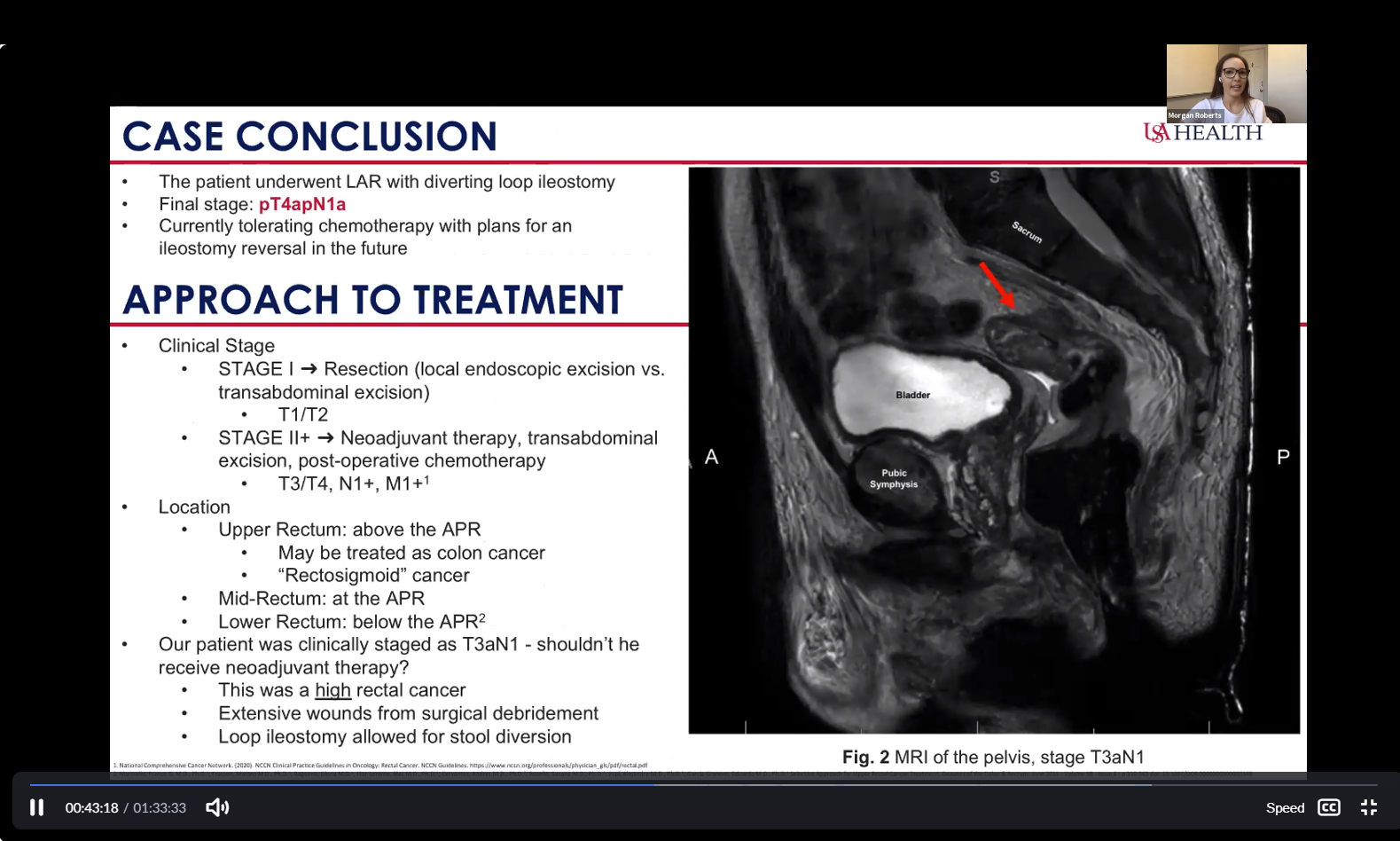
Morgan Roberts presents 'Incidental Discovery of Colorectal 
Cancer in a Patient with Fournier’s Gangrene' during the 
M3 Case Symposium.

3rd Place (Tie)
Morgan Roberts: "Incidental Discovery of Colorectal Cancer in a Patient with Fournier’s Gangrene"
Faculty sponsor: John Hunter, M.D.
Alexis L. H. Kentros and Kay Ann Simmons: "Urine Leaking from Surgical Site"
Faculty sponsors: Paul Rider, M.D., and Lorie Fleck, M.D.

Jacob Rosner, who received first place for his presentation, collaborated with Jennifer Scalici, M.D., chief of gynecologic oncology at USA Health Mitchell Cancer Institute. Their case concerned a patient with stage IA grade 2 endometrial cancer.  

"Although surgical intervention is the gold standard for this stage and grade, Dr. Scalici and I discussed her significant comorbidities and how some patients do not perfectly fit into algorithms," Rosner said. "She presented to USA Health a few months after surgery with various medical problems that were not directly related to her cancer but may have been exacerbated by her surgery."

The case highlighted other issues such as how socioeconomic status and living in rural Alabama contributed to the patient's limited access to care and follow-up treatment, Rosner said.  

Stuart McFarland, student assembly president, said many students already had started preparing for the case symposium before COVID-19 restrictions prevented medical students from clinical rotations in the hospitals. McFarland said the assembly decided the best way to proceed was to host the symposium online in lieu of traditional poster presentations. 

"Due to the limitations of small computer screens instead of posters, we went with short oral presentations with PowerPoint presentations," McFarland said. "This style was new to many of us. I believed the added challenge forced us to think outside the box and resulted in excellent presentations."

Rosner said the format, in which participants were separated into four Zoom rooms, seemed to work well. "Although we were not able to see everyone's poster presentation as in years past," he said, "it was nice to listen and focus more clearly on a select few."

McFarland added, "Because of the new format we also needed significantly more judges. I was very grateful for all the faculty members who stepped up and offered their expertise."

Thursday, June 18, 2020

Class of 2022 medical students to receive white coats

The University of South Alabama College of Medicine will host its annual White Coat Ceremony at 11 a.m. on Friday, June 19, by Zoom.

During the ceremony, rising third-year medical students in the Class of 2022 will don their white coats, the traditional dress of physicians for more than 100 years.

“I am excited to finally learn the art of doctoring from our highly skilled faculty,” said medical student Zack Aggen. “It feels like I’ve been grinding for two years to get to this point. These next two years will be a thrilling experience.”

Aggen, who is class president, will lead his classmates in the Medical Student Oath via Zoom.

Select students from the class of 2021, along with residents and faculty members, will be inducted into the Gold Humanism Honor Society during the ceremony. Inductees are chosen by current third-year medical students for practicing patient-centered medical care with altruism, integrity and compassion.

Each year, the USA Medical Alumni Association sponsors the event.


Wednesday, June 17, 2020

MedPride celebrates contributions of Black activists

This month, the members of the MedPride and Allies interest group are sharpening their message for Pride Month, which celebrates the birth of the modern LGBTQ+ movement. In support of Black Lives Matter, they want to emphasize the role that Black activists have played in advocating for LGBTQ+ rights.

“There would absolutely be no Pride Month and nothing to celebrate if it weren’t for LGBTQ+ people of color who were on the front lines at the Stonewall riots,” said Tyler King, co-president of the interest group at the University of South Alabama College of Medicine.

King was referring to the Stonewall rebellion, which took place in New York on June 28, 1969, in which demonstrators fought back against police raids on bars that catered to LGBT patrons. Black transgender activist Marsha P. Johnson, who died in 1992, was among the influential figures who contributed to the riots.

“We want to praise them and make them visible during this really important time in our history,” King said.

MedPride and Allies is spotlighting Johnson and others on its Facebook page, including Audre Lorde, an activist who used poetry and other writings to inspire Black women; Christian Cooper, a gay writer and editor for Marvel Comics and now senior biomedical editor at Health Science Communications; and Lori Lightfoot, who became Chicago’s first Black female and openly LGBTQ+ mayor in 2019.

This week, MedPride is also partnering with the Student National Medical Association, Rainbow Mobile and the Mobile Bevy to raise awareness about Juneteenth, which commemorates the end of slavery in Texas more than two years after the Emancipation Proclamation was issued. MedPride and Allies is hosting an online fundraiser for Black Visions Collective, a Black-led, queer- and transgender-focused nonprofit based in Minneapolis-St. Paul, Minn.

King said that the MedPride and Allies interest group was re-energized at the USA College of Medicine in 2018. With nine officers, it draws 20 to 30 people to its regular meetings. “Our main mission is to provide a safe place and place of togetherness for any LGBTQ+ students that we have in the College of Medicine or in Basic Medical Sciences,” she said. “Secondly, we want to raise awareness of LGBTQ+ health inequities, especially in the South.”

This week also witnessed the landmark U.S. Supreme Court ruling on LBGT rights, in which the court said that existing federal law forbids job discrimination on the basis of sexual orientation or transgender status. King called the decision “huge” but said there is still more to fight for.

“I’m incredibly grateful for the people who have fought every single day for this,” she said. “We will celebrate this while also realizing we must continue to push for equality and protection of our transgender community.”

Tuesday, June 16, 2020

Zeidan navigates medical school, family life during pandemic

During her final law school exam in 2007, Melody Zeidan remembers staring out a window, reflecting on her decision to choose a legal career over one in medicine.

“I was pre-law and pre-med during undergrad. I always wanted to be a doctor,” she said, explaining that her father always dreamed of his daughter becoming an attorney.

She graduated from Vanderbilt Law School, passed the bar and spent 10 years working at firms in Birmingham and Mobile. Along the way, she and her husband, Ali Zeidan, welcomed three children into the family. As the years passed, her desire to become a physician remained strong.

While still practicing law, Zeidan returned to college to complete the courses required to apply for medical school. She also took a job working nights as an emergency room scribe at a local hospital. It was during those evening shifts, where she took meticulous notes for physicians, that her decision to change careers was cemented.

A member of the class of 2022 at the University of South Alabama College of Medicine, Zeidan picked up a new white coat recently from a local uniform store to unofficially mark the beginning of her clinical duties as a third-year medical student this summer. The jackets of third and fourth-year medical students are differentiated from others by monogramming and a special patch.

“When I decided to go back to medical school, I knew it was going to be a 10-year journey,” she said. “I tell people no decision ever has to be final. Just because you decide to do something with your life doesn’t mean you can’t change your mind.” 

Medical student Melody Zeidan and her three children gather
around the dining room table to complete their schoolwork.
The last few months of her journey, though, have been interrupted by the COVID-19 global pandemic, which closed schools and universities to on-campus learning across the United States. Zeidan worked to complete her second-year studies in the afternoons, evenings and sometimes early mornings so she could be a stand-in school teacher to her children: Bear, age 11; Elle, age 9; and Lex, age 8.

From March until mid-May, her family of five worked exclusively from home, using their dining room as a makeshift classroom and office.

“A lot of my classmates were facing stress over board exams and whether we would be able to start our clinical duties in June as scheduled,” Zeidan said. “But honestly, I was just doing all I could to keep my head above water. I figured I would deal with the future when it arrived.”

Zeidan said her classmates at USA have remained in contact through the GroupMe app. “We have always done most of our class-wide communication through that platform or email.”

Sticking to a schedule at home has helped: “I’ve tried to maintain as much normalcy as possible in such a strange situation, to try to keep our stress levels down. We are all healthy and together. ... It’s a challenge, but we’ll get through it.”

Zeidan grew up in Wilcox County, Alabama. The daughter of a school teacher, her father served on the local school board. She was accepted into the Alabama School of Mathematics and Science (ASMS) her junior year and graduated at age 16. She earned an undergraduate degree from the University of Alabama, where she also met her husband.

Leaving home and attending the school of math and science in Mobile, she said, changed her life. “It was the best thing my parents ever did for me. It was my first exposure to anything outside of Wilcox County. I got so much encouragement there to learn.”

During certain semesters in high school, she traveled abroad for the first time and fell in love with the theater. Zeidan is already good with a needle, hand-making pageant costumes and more recently cloth face masks in her spare time. She also volunteers with the Junior League of Mobile and the Big Brothers Big Sisters of South Alabama mentoring program.

Zeidan serves as the research co-chair for USA’s Student Run Free Clinic. She’s also the finance chair-elect for the International Society of Student Run Free Clinics.  She serves as the vice president of the Medical Spanish Interest Group and community service chair of the American Medical Women’s Association.

Zeidan said she’s interested in plastic surgery but keeping her options open: “The focus on both form and function in plastic surgery speaks to my creative side, and I think I would really enjoy doing reconstruction after traumatic injuries or cleft lip/palate repair. It’s still pretty early, though, so all I know for sure at this point is that I want to do a lot of procedures.”